
Meta Description: Choosing an amphibious excavator for mangrove channels, tidal wetlands and coastal maintenance requires more than tonnage. This guide covers water depth, ground pressure, pontoon design, working reach, attachments and transport conditions for Southeast Asia projects.
Mangrove forests, tidal creeks, coastal wetlands and shrimp pond channels are some of the most challenging jobsites for any excavator. You are not just dealing with mud. You are dealing with: · Soft, saturated peat and clay · Daily tidal changes · Shallow but silty channels · Root systems and tangled vegetation · Limited access roads · High humidity and corrosion · Restricted space for turning and assembling equipment
A standard crawler excavator will struggle to move. A generic amphibious excavator may float, but it can still get stuck in soft mud, lose stability during tidal currents, or fail to handle the combination of dredging, vegetation clearing and channel maintenance.
From our experience supplying amphibious excavators to projects in Indonesia, Malaysia, Thailand and Vietnam, the best machine for this region is not the one with the largest advertised tonnage. It is the one matched to mangrove conditions: low ground pressure, stable pontoon hulls, good flotation, suitable working reach and strong hydraulic compatibility for multi-purpose attachments.
Before comparing amphibious excavator models, answer these site questions first:
1. What is the normal and maximum tidal water depth?
2. Is the bottom soft mud, peat, clay, sand or a mix?
3. Do you need to work during high tide, low tide or both?
4. What is the required digging depth or channel depth?
5. What working radius do you need from the machine position?
6. Are you clearing vegetation, dredging silt, maintaining ponds or reshaping banks?
7. Can the site accommodate a wide machine, or is narrow access critical?
8. How will the machine be transported to the project area?
These questions matter more than operating weight. Two 20-ton amphibious excavators can perform very differently in the same mangrove channel, depending on pontoon size, hull shape, weight distribution and hydraulic configuration.
Water depth is one of the first parameters to confirm, but it must be reviewed together with tides, currents and bottom conditions.
In mangrove areas, the same site can be: · Shallow and exposed at low tide · Partially submerged at high tide · Influenced by daily current changes
This means the amphibious excavator must remain stable and mobile across different water levels.
A common mistake is selecting a machine only by advertised “maximum water depth.” In real mangrove work, the important question is: Can the machine stay afloat, maintain position and continue working when the water level and ground conditions change?
For many Southeast Asian mangrove and coastal projects, practical considerations include: · Hull buoyancy at different tide levels · Stability during incoming or outgoing currents · Ground clearance on soft mud at low tide · Risk of grounding in shallow channels · Need for spuds or positioning assistance
When requesting a quotation, provide: · Normal water depth · Maximum water depth · Tide range · Current conditions · Bottom type
This allows the supplier to recommend the right pontoon configuration rather than simply quoting a standard machine.
For mangroves and tidal wetlands, ground pressure is often more important than machine weight.
Soft mud, peat and saturated clay have very low bearing capacity. A machine with heavy concentrated loads can sink, even if it has tracks.
An amphibious excavator improves flotation by using pontoon-style hulls that spread the machine weight over a larger contact area. However, lower ground pressure does not mean the machine will never sink. Actual performance depends on: · Operating weight · Pontoon length and width · Contact area · Hull shape · Soil bearing capacity · Mud depth · Attachment load
In Indonesia and Malaysia mangrove projects, we often see machines with acceptable tonnage but poor hull design sink or become immobile during long periods of low tide. The solution is not always a bigger machine. It is a better balance between hull buoyancy, weight distribution and ground pressure.
JINGGONG amphibious excavators are designed with reinforced pontoon hulls to distribute weight more evenly across soft wetland surfaces. This helps reduce sinking risk in mangrove mud, peat and saturated clay, compared with machines that use narrower or less optimized undercarriage structures.
The pontoon hull system is the most important structural difference between an amphibious excavator and a standard crawler excavator.
For mangrove work, evaluate the pontoon system based on: · Hull length · Hull width · Contact area · Buoyancy · Track layout · Weight distribution · Additional side pontoons · Spud or stabilizer options
Wider pontoons can improve stability, but they may also increase transport difficulty. The best configuration for Southeast Asia projects is often a balance between on-site performance and practical logistics.
Mangroves usually require: · Good stability during side reach work · Ability to work near channel banks · Resistance to uneven soft ground · Durability against mud, roots and abrasive sediment · Corrosion protection in coastal or brackish water
JINGGONG amphibious excavator pontoon structures are engineered for wetland and coastal conditions. The hull design supports flotation in shallow water while the track system helps transfer traction on soft mud. For projects requiring extra stability, optional side pontoons or positioning systems can be added according to site demand.
This makes the configuration more flexible than one-size-fits-all amphibious machines, especially for contractors who move between mangrove channels, pond maintenance and coastal protection sites.
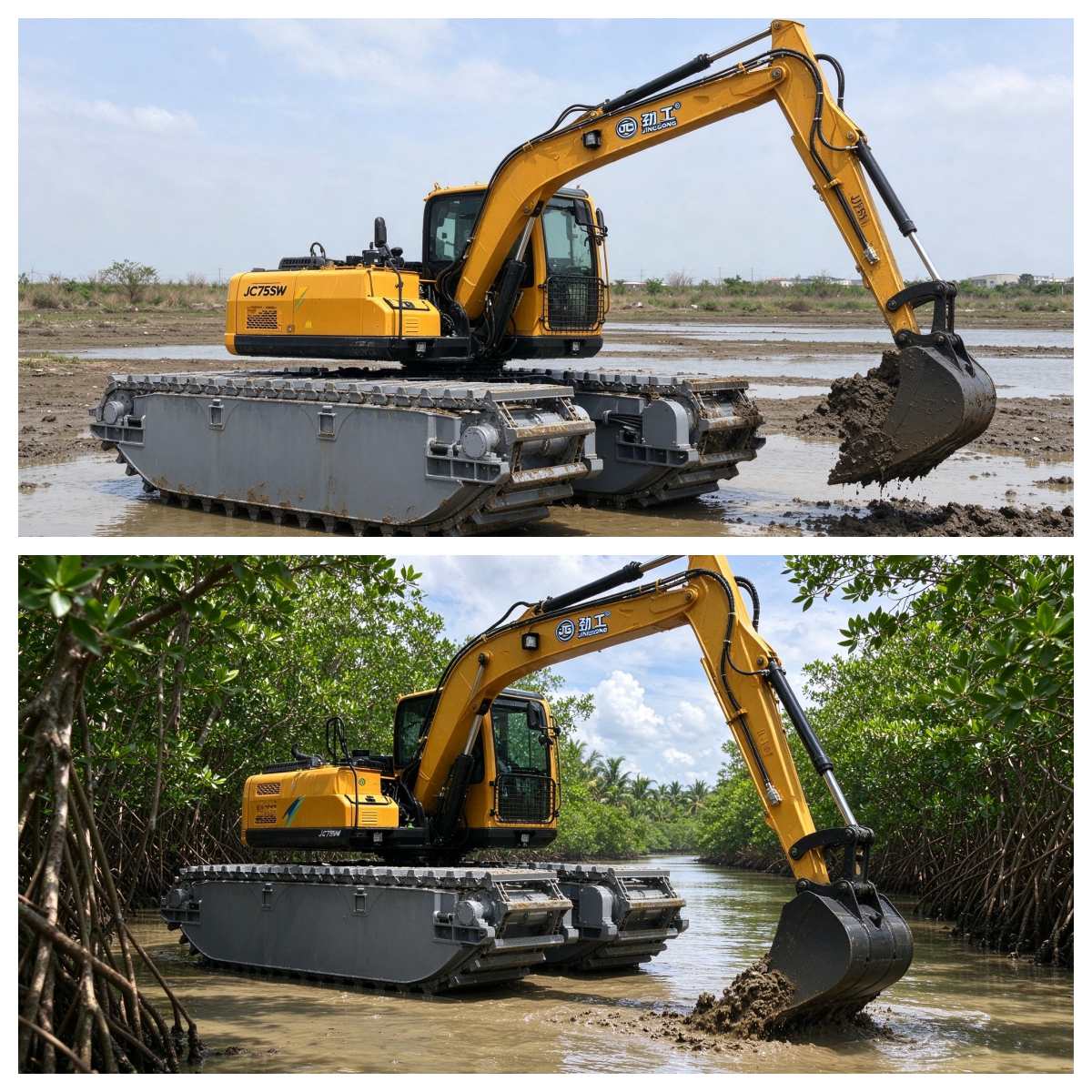
A longer boom sounds better, but it is not always more productive.
In mangrove channels, you often need to reach the bank without driving the machine too close to soft edges. However, excessive working reach increases load moment and can reduce practical digging performance.
The correct approach is: Choose the shortest boom and arm combination that can safely complete the required work.
This helps maintain: · Better digging force · Higher bucket capacity · More stable operation · Lower stress on the hull and undercarriage
For mangrove applications, typical reach-related tasks include: · Channel dredging from a stable position · Bank shaping · Cleaning sediment from pond edges · Reaching over roots and vegetation · Working along narrow tidal creeks
If the required working radius is 10 meters, selecting a much longer boom just for the extra maximum reach will not necessarily improve production. It may instead reduce attachment capacity and require additional stabilization.
JINGGONG works with customers to match boom and arm length to the actual channel width, bank height and dredging depth. Instead of offering a single long-reach option, we help select a practical configuration that balances working reach, stability and bucket performance for Southeast Asia mangrove jobsites.
Mangrove projects are rarely single-purpose. One day you may be dredging silt; the next day you may be clearing roots, trimming banks or cleaning channels.
That means the amphibious excavator should be prepared for multiple attachments from the beginning.
Common combinations include:
Application
Recommended Attachment
Soft silt and mud removal
Dredging bucket / cleaning bucket
Channel maintenance
Ditching bucket
Mangrove roots and vegetation
Cutter / mulcher
Logs, debris and root removal
Grapple
Bank shaping and slope work
Grading bucket / tilting bucket
Hard clay or compacted layers
Heavy-duty bucket
The biggest mistake we see in the field is customers selecting the base machine first and then trying to fit attachments later. In an amphibious excavator, the attachment weight, mounting dimensions, hydraulic flow and hull stability are all connected.
For example, a heavy cutter or long-reach arm changes the machine’s center of gravity. A dredging pump requires specific hydraulic flow and pressure. If these are not planned early, the machine may become unstable, underpowered or difficult to control.
JINGGONG amphibious excavators can be configured for mangrove work with different attachment packages, including dredging buckets, ditch cleaning buckets, cutters, mulchers and grapples. By matching the hydraulic system, boom length and pontoon layout to the attachment at the quotation stage, the complete machine is more reliable on site.
Hydraulic performance matters a lot in amphibious excavator work, especially when using powered attachments.
Two machines of similar tonnage can have very different auxiliary hydraulic capabilities. For mangrove and wetland projects, you should check: · Hydraulic flow · Hydraulic pressure · Auxiliary circuit specifications · Continuous flow capacity · Coupling and hose requirements · Compatibility with cutters, mulchers or dredging pumps
A standard bucket puts less demand on the hydraulic system than a cutter or dredging pump. If the hydraulic system is marginal, adding a high-demand attachment can slow the machine, reduce efficiency and increase component wear.
JINGGONG amphibious excavators are configured with hydraulic systems designed to support multi-purpose wetland work. This is particularly useful in Southeast Asia, where contractors often switch between dredging, vegetation clearing and channel maintenance on the same project.
Instead of treating the base machine and attachments as separate purchases, we recommend specifying the complete working system at the start: base machine + pontoon hull + boom/arm + attachment + hydraulic package.
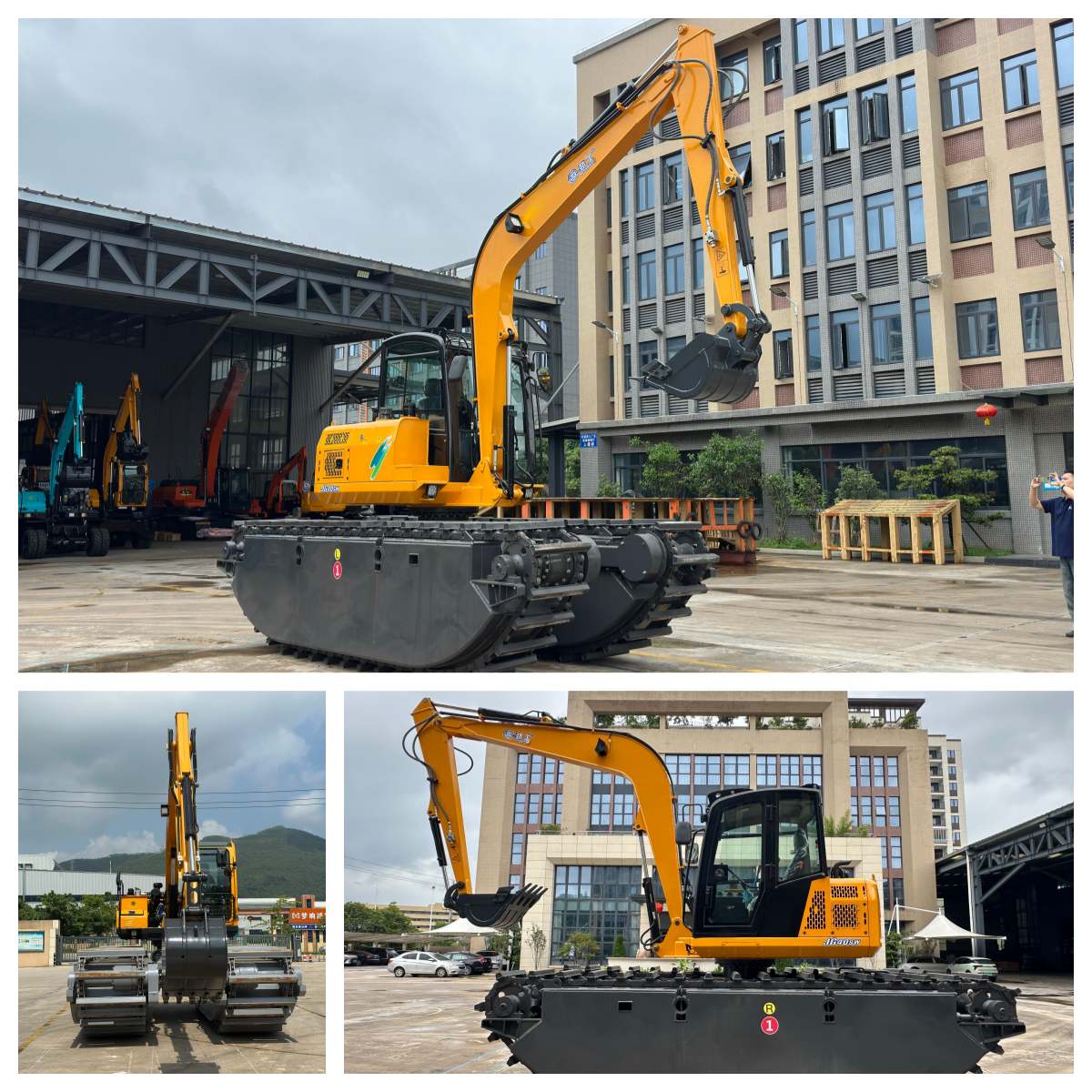
An amphibious excavator can work perfectly on paper but still fail commercially if it is too difficult to mobilize.
This is especially true in Southeast Asia, where project locations may include remote coastal areas, small islands, mangrove reserves and pond farm zones.
Before purchasing, check: · Transport length · Transport width · Transport height · Total weight · Pontoon dimensions · Dismantling requirements · Trailer access · Container loading possibility · Assembly area availability
For many contractors in Indonesia, Malaysia, Thailand and Vietnam, transport practicality is a major decision factor. A machine that is too wide or too heavy may require special permits, larger trailers and more expensive logistics.
JINGGONG designs amphibious excavator structures with transport and assembly in mind. The modular pontoon hull layout helps reduce assembly complexity, while the compact configuration allows easier movement between project areas in Southeast Asia. For export markets, the machine can also be prepared for container shipment or standard trailer transport, depending on the model and project requirements.
Most buyers focus on buoyancy and reach, but corrosion is a hidden cost in mangrove and coastal projects.
Brackish water, humidity, salt spray and muddy sediment can accelerate wear on: · Undercarriage components · Track links · Pontoon hulls · Hydraulic pipes · Frame connections · Electrical parts
A machine that works well in inland wetlands may show corrosion problems much faster in coastal mangrove areas.
Practical durability checks include: · Hull material and coating quality · Corrosion protection on metal structures · Seal and component protection · Track and link durability · Ease of cleaning after muddy work
JINGGONG amphibious excavators are built with reinforced pontoon hulls and structural protection suitable for wetland and coastal operating conditions. For saltwater or high-humidity projects, additional corrosion protection can be arranged according to customer requirements.
When you contact a supplier, provide these parameters to get a more accurate configuration:
1. Application: mangrove dredging, channel maintenance, pond cleaning, vegetation clearing, coastal protection
2. Water depth: normal, maximum and tidal range
3. Bottom conditions: mud, peat, clay, sand or mixed
4. Current or tide conditions: strong current, calm water, daily tidal change
5. Required digging depth: in meters
6. Working radius: horizontal reach needed from the machine position
7. Attachments: dredging bucket, cutter, mulcher, grapple, ditching bucket, etc.
8. Machine width limit: site access and transport restrictions
9. Transport method: trailer, container, barge or local road transport
10. Environmental conditions: brackish water, high humidity, coastal corrosion risk
The more specific you are, the easier it is for the supplier to recommend the right amphibious excavator configuration.
Mistake 1: Choosing only by tonnage A 20-ton amphibious excavator is not automatically better than a smaller model for mangrove work. Weight alone does not tell you about ground pressure, pontoon buoyancy or stability.
Mistake 2: Confusing water depth with digging depth Water depth is the depth of the jobsite. Digging depth is the maximum depth the machine can reach. They are different measurements.
Mistake 3: Buying a long boom for every project Long booms increase reach, but they can reduce bucket capacity and stability. Match the boom to the actual job.
Mistake 4: Adding attachments after delivery Power attachments affect stability and hydraulic demand. They should be included in the initial specification.
Mistake 5: Ignoring transport cost A wide, heavy machine may perform well on site but become uneconomical due to mobilization costs.
Mistake 6: Forgetting corrosion Coastal mangrove conditions are more aggressive than many inland jobsites. Corrosion protection should not be an afterthought.
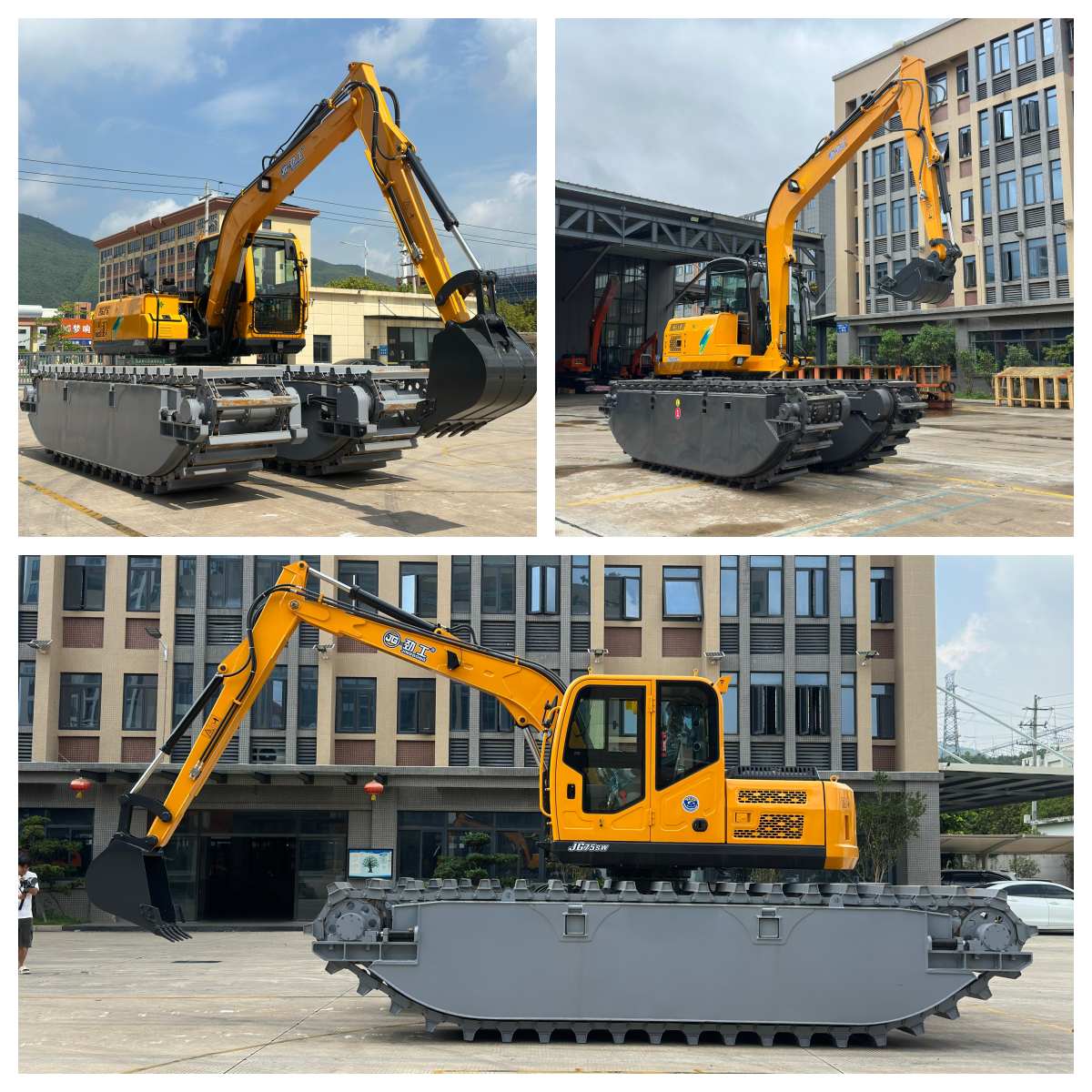
What is an amphibious excavator used for in Southeast Asia? Amphibious excavators are commonly used for mangrove dredging, wetland maintenance, channel clearing, pond cleaning, shoreline protection, flood control and soft-ground excavation in areas where standard excavators cannot operate.
Can an amphibious excavator work in mangroves? Yes. Amphibious excavators are particularly suitable for mangroves because their pontoon hulls improve flotation and distribute weight over soft mud. However, performance still depends on ground pressure, pontoon design, water depth and stability.
How deep can an amphibious excavator work in mangroves? There is no single standard depth. The practical working depth depends on pontoon buoyancy, hull design, tide level, bottom conditions and the machine’s stabilization system.
Which attachment is best for mangrove dredging? Soft silt and mud are usually handled by dredging buckets or cleaning buckets. If you need to pump material through a pipeline, a hydraulic dredging pump may be more suitable. For roots and vegetation, a cutter or mulcher is often used.
Is a longer boom better for mangrove work? Not always. A longer boom increases working reach but can reduce practical digging force and bucket capacity. It is better to select the boom length based on the required working radius and channel depth.
Mangrove and coastal wetland projects in Southeast Asia demand more than flotation. They demand a machine that can handle soft mud, tides, shallow channels, vegetation, corrosion and transport restrictions.
The best amphibious excavator is not the largest one available. It is the one whose pontoon hull, ground pressure, working reach, attachment package and hydraulic system match the actual site conditions.
JINGGONG focuses on practical configurations for wetland and coastal projects. Instead of offering a generic amphibious excavator, we work with contractors to select the right hull size, boom length, hydraulic package and attachments based on the project parameters.
If you are preparing for a mangrove dredging, channel maintenance, pond cleaning or coastal protection project, please share your water depth, ground conditions, required reach and transport requirements. We can recommend a more suitable amphibious excavator configuration for your site.
No. 88 Pancuo, Jiaonan Village, HeShi Town, Luojiang District, Quanzhou, Fujian, China
tel : +8618805957336
WhatsApp : +8618805957336
e-mel : winny@fjjgjx.com
 rangkaian ipv6 disokong
imbas ke wechat :

 tel : +8618805957336
 e-mel : winny@fjjgjx.com


 peta laman


